Electricity in Vatican City: Plugs, Adaptors and Charging for Your Visit

Vatican City uses 230V, 50Hz with Type C, F and L connections. Most visitors charge at accommodation in Rome before arriving, so pack for Italian sockets as well. Do not plan on finding a spare charging outlet during a museum tour.
Recognise the plug types
Type L has three pins in a straight line, with different 10A and 16A sizes. It is not the triangular Israeli Type H.
Type C is a slim two-pin plug; Type F has side earth contacts. Combination outlets accept several formats, but are not installed everywhere.
Check physical fit
A slim Europlug may fit a compatible socket directly, while a thick European plug will not fit every small Type L outlet.
Bring an adaptor explicitly suitable for the outlet and your own plug. British, North American and Australian plugs need appropriate adaptation; preserve earth where required.
Type L sockets, a type also used in Vatican City: 16A left and 10A right, with different hole spacing. · Carnby · Public domain · Unmodified

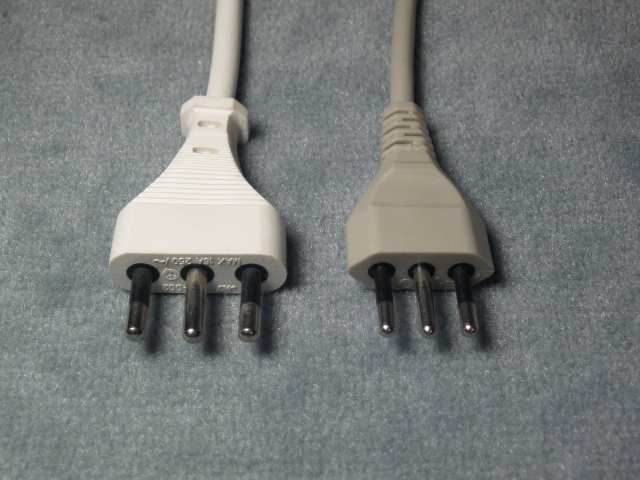
Type L plugs have three pins in a straight line, unlike the triangular Israeli Type H. · Marco Gilardetti · CC BY-SA 3.0 · Unmodified


A combination socket designed for several plug types. This configuration is not universal. · Germarquezm · CC BY-SA 3.0 · Unmodified

Match voltage and frequency
The supply is 230V, 50Hz. A 100V-only or 120V-only appliance must not be connected through a simple shape adaptor.
Motors and frequency-sensitive equipment need compatibility with 50Hz too. Check the manufacturer’s rating rather than the country in which you bought it.
Read the input rating
INPUT 100–240V, 50/60Hz normally indicates mains compatibility. USB OUTPUT ratings refer to power delivered to your device, not accepted wall voltage.
Inspect camera chargers, toothbrushes and medical equipment separately. A photograph of each label helps when checking before travel.
Adaptors, earth and power
An adaptor changes plug shape, not voltage. Use a reputable, correctly rated product and maintain earth continuity for appliances needing it.
Do not bend or remove pins or stack improvised adaptors. A locally supplied hairdryer is usually simpler than adapting an incompatible high-power appliance.
Prepare for a full day
Charge your phone and power bank before leaving and bring the right cable. Pack headphones if a booked audio guide runs on your own phone. Save admission details offline.
Ask before using any outlet in a visitor site. Apparently unused sockets may serve building equipment; a power bank avoids making the visit depend on finding one.
At accommodation in Rome
A compatible multi-port charger can serve several devices. Check whether the key-card switch disables room outlets, and keep charging equipment dry and ventilated.
In an apartment, simultaneous high-power appliances can trip protection. Contact the host rather than bypassing it, and stop using damaged or overheating outlets.
Power interruptions
Follow staff instructions inside visitor sites. For Rome accommodation, ask reception about a local failure; the Areti outage map concerns Rome and Formello, not the Vatican’s internal electrical systems.
Arrange backup power in advance for essential equipment. EV charging requires a suitable authorised station, not a travel adaptor connected to an arbitrary wall outlet.