776 results found with an empty search
- Austrian National Library State Hall
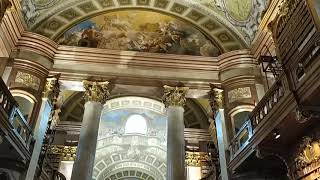
The state hall was built in the 18th century as part of the Imperial Court Library. The books have been collected since the middle of the 14th century by the emperors. The state hall is marvelous. Looking at the old books makes you feel like you are inside a chapter of Games of Thrones or Harry Potter. There are explanation plates that tell the history of this unique library, and I found it extremely interesting. Tip: buy your tickets online. You don't need to print them, so you can do it onsite. Also, it's much faster than waiting: To the Austrian National Library Website
- The Imperial Crypt
The Capuchin Church in Vienna is hosting The Habsburg Dynasty Imperial Crypt since 1633. One hundred fifty family members are buried here, including 12 emperors and 18 empresses. The house of Habsburg was a central royal house in Europe. The house rules the Holy Roman Empire, and for varying periods, ruled the Kingdoms of Bohemia, England, Germany, Hungary, Croatia, Illyria. Ireland, Portugal, and Spain, alongside the Second Mexican Empire and more. The central axis of the Habsburgs was the ruling the Duchy of Austria and the Kingdoms of Bohemia and Hungary. Visiting the Crypt takes 30-40 minutes. It's an excellent reminder of the fact that even kings and emperors eventually die.
- St. Stephan Cathedral in Vienna
Saint Stephan Cathedral in Vienna is one of the city's symbols and the sitting place of the Catholic Archbishop of Vienna. The cathedral was built in 1147 and rebuilt in a gothic style in the 14th-century. When I visited, it wasn't possible to see the whole church because of a fence they built to avoid access. However, they were arrangements for a concert, so maybe it is possible at different times. In any case, this is an imposing church located in Stephanplatz, the most central place in the city, so it is worth paying a short visit.
- Sigmund Freud Museum in Vienna
Sigmund Freud was a Jewish-Austrian psychiatrist and neurologic. He lived and worked in Vienna until 1938 when the Nazis forced him to leave. He founded the Psychoanalysis theory and became one of the most influential scientists in the 20th-century. The Sigmund Freud Museum is located in Freud's house and clinic for 47 years. Unfortunately, the museum has only one renovated room. The other rooms display images and items of Freud, which you can learn about using a detailed guide on your smartphone. The museum is not impressive at all. I saw that they intend to redesign in the coming years – I sure hope so. Freud deserves more than that. To the Museum Website
- Schönbrunn Palace and the Strudel Show
The Schönbrunn Palace is a UNESCO World Heritage Site and one of the major tourist sites in Vienna. It was the palace of the emperors and empresses from the end of the 17th century. Franz Josef made it his primary residence. Today it serves as a museum. There are two options for tours in the palace. The shorter takes 40 minutes, while the more extended trip takes 20 minutes more. Due to the mass of visitors, the tourists move together from room to room, accompanied by an excellent audio guide. Unfortunately, it's not allowed to take pictures. So you will have to come and see those great rooms yourself. I highly recommend buying tickets online in advance - the entrance is by time slots, and if a time slot is occupied - you won't be able to come in. Also, reservation tickets online will keep you from hours of waiting. Behind the palace lies a vast park, which during our visit was covered with snow. Beautiful. The Strudel Show The Residenz Cafe is now running where the palace's bakery used to be. It runs the Strudel Show every 20 minutes (Reserve your place online!). A bilingual guide explains in German and English how to prepare a strudel while preparing. And of course, you can watch it while you eat a great piece of strudel. They even give the recipe in the end. It was fun and tasty. To the Schönbrunn Palace Website To the Strudel Show Website The Strudel Show
- Christmas Markets in Vienna
The main advantage of visiting Vienna in December is the Christmas Markets. In Israel, as a Jewish state, we celebrate Hanukkah – for eight days, we light candles in the Menorah with the whole family. So, therefore, visiting Christian countries in winter, with all the lights and colors, is such a big deal. It's hypnotic. And Vienna is a great place for Christmas feeling. Tens of Christmas Markets are spread all over the city, making a celebration from each evening. On our first evening, we visited the most significant Christmas Market at Rathausplatz, with its 150 stalls of decorations, food, and punch. On the second and the third evenings, we visited the Christmas Market at Stephanplatz. The market itself is not large, but the whole area is decorated and full of lights and colors. On our last night in Vienna, we visited the Christmas Market of Schönbrunn Palace, which has excellent food, but no hotdogs… weird. Each market is characterized by its own punch glasses. So we took back three of them as a reminder:
- Naschmarkt
The Naschmarkt is the most famous market in Vienna, and it is 1.5 km long. The market was founded in the 16th century. You can find all kinds of fruits, vegetables, herbs, cheese, fish, meat, pastry, and seafood. In addition, lots of restaurants and street food stalls are spread all over the market. To the Naschmarkt Website
- Viktor Frankl Museum
Viktor Emil Frankl was a Jewish-Austrian Psychiatrist and neurologic who founded Logotherapy. He published 32 books, among them the most famous "The Man's Seeking for Meaning" that describes his experience as a prisoner in Nazi concentration camps, including Auschwitz-Birkenau, and emphasizes the central importance of finding a destination in life to overcome trauma. The small museum located in his house focuses on Frankl's treatment method and tries to give simple examples of the theory and its rationale. I found it very interesting, and I indeed recommended it for travelers who have the patience to read and learn. It's not allowed to take photos inside, so I only took a picture of the building. To the Museum Website
- Gasometer
At the end of the 19th-century, Vienna City built four large gas tanks. They were used until 1984, when the use of natural gas made them unnecessary. The brick frame of the enormous structures was preserved, while the interior design adjusted to the new purpose: residence, commercial, and entertainment. It's a beautiful example of urban creativity. To the Gasometer Website
- Farod Stream
A stunning route that has it all: blooms, cows, running water, small waterfalls, dozens of places for a picnic. From the Nahal Farod parking lot, pass through green fields where cows graze and descend the route below. The walk is along the creek that is now flowing, and it is beautiful. There are many places where you can stop, sit on the banks of the stream, and have a picnic. A great place. Enjoy🤗
- Farod Waterfalls
Beautiful waterfalls in a forest. Near the parking lot, you will find many places for picnics and the stream that flows in the center. The natural beauty is up the hill. You enter Mount Meron National Park from the forest and walk up through the bushes to the waterfalls. At first, large pipes significantly spoil the view but do not despair - a few minutes up, and you reach the magic. You can sit on areas of beautiful waterfalls and small pools next to them. Children happily played between the pools and moved from side to side. The route is linear. You can decide how far you want to go - at the end of the route, you reach Moshav Sheffer. On the way, you might even see cows. It is worth traveling soon because as you move away from the rainy days, the flow will disappear, and the stream will dry up. Enjoy 🤗
- The Syrian Tank in the Banias Nature Reserve
A beautiful hike in the middle part of the Banias stream. It includes a hike to the inverted Syrian tank and a walk on the route on the banks of the Banias. The starting point is in the cemetery of Kibbutz Snir. From there it is a descent of about a quarter of an hour to the inverted Syrian tank. Why is the tank there? During the Six-Day War, it was part of the Syrian attack on Kibbutz Dan. During the battle with the Israelis, the tank retreated, fell into the stream, and remained there. From there, repeat on the black trail until the intersection with the words "Sh’aar Yeshuv" written on it and walk along the path. The route overlooks the stream, sometimes it is on the banks of the creek. Parts of it are exposed to the sun and in parts, there is a feeling of walking in a Thai jungle. From here you can decide whether to return or continue until Sh’aar Yeshuv. Please note - the Banias flows vigorously along the entire route. You cannot swim in these areas - it is very dangerous. Enjoy🤗