776 results found with an empty search
- Gamla National Park
Gamla National Park is a great place to hike in the southern Golan. You will find a variety of routes and views of stunning landscapes. Here are three of the trails I hiked: 📌 The Eagles Trail - Gamla Lookout is a short and accessible circular trail of about half a kilometer that leads to both the Eagles Lookout (with information about the Sisera Eagle and the whole issue of eagles in the Golan) and observation of Gamla Old City. 📌 The dolmen trail to Gamla waterfall - about 1.5 km (line: back and forth on the same road). Through the dolmen field to a stream that crosses Nahal Gamla and a view of the beautiful waterfall: the highest solid waterfall in the country. 📌 The Dalyot Falls - about 3 km of walking on the cliff, descending to the river, and climbing towards the Dalyot parking lot. The views from the cliff are amazing. Since we were with two vehicles, we put one in Gamla and the other in the Dalyot parking lot. If you have one car you need to go back all the way. Enjoy🤗 For more trips in the area, press here.
- The Black Waterfall in Nahal El Al
The Black Waterfall in Nahal El Al is a perfect route with water. At the beginning of the road, you will see the Mitzpe HaBanim - a memorial to two soldiers killed in Operation Defensive Shield. With the click of a button, you will hear about the place and the two soldiers - Pinchas Cohen and Shmulik Toledano. The monument inaugurated in 2019 is also a beautiful viewpoint over the area. The beginning of the route is a plane. After that, a descent begins, ends with a few pegs, and then you reach the waterfall, which falls into a stunning pool. The water is cold and fun, and even some fish float there happily. Before entering or returning to the route, there is a coffee cart with popsicles and a cold drink. Necessary after the return ascent ... Enjoy🤗 For more trips in the area, press here.
- Meizar Stream
An amazing route in the southern Golan Heights A linear route of about 6.5 km of walking on a green and beautiful path in front of the Golan Heights. The route consists of two parts. The first part is the green route. In the end, cross a road and reach a point from which you go out to observe the waterfall and the stream. f you are with one vehicle, you can travel separately to both sides: go down the Strait River until you are tired and then return and then travel with the vehicle to the waterfall area. From there, it is an 800-meter walk to the lookout. If you want to go down to the pool, it is a few hundred meters further. This is also a linear route. Repeat the same way. Enjoy🤗 For more trips in the area, press here.
- The Shalom Observatory (Mitzpe HaShalom)
An amazing trip to the southern Golan Heights full of crazy views of the Sea of Galilee. 📍We started at The Shalom Observatory (Mitzpe HaShalom). From the large plaza, there is an observation of the entire Sea of Galilee. 📍From there, go down the stairs to the Maayan Hashalom pool: a small pool of stream water. 📍The pool is part of a circular route - the Garden Trail: an easy walk in a stunning grove while observing the Sea of Galilee. 📍When you return, you can continue to the Haon Cliffs promenade. It is accessible for the most part and reaches as far as a Mavo Hama. The promenade overlooks the Sea of Galilee. Enjoy🤗 For more trips in the area, press here.
- Tel Saki
Tel Saki in southern Golan Heights is the site of one of the most famous battles of the Yom Kippur War. Every battle is hard and shocking, and this battle has become famous both because of a series of crazy events that happened in it and also because it was recently commemorated in the TV series "Sha’at Neyila". In October 1973, when the Yom Kippur war broke out, Syrian forces broke through the border in the direction of the hill. A bloody horrific battle took place there in which 32 IDF soldiers were killed. 28 soldiers managed to hide in a small bunker. One of the wounded there who was injured and became deaf shouted that he wanted water. They tried to shout back at him to keep quiet because the Syrians would find them, but he did not hear and kept shouting. The commander decided that they should strangle him to save everyone. In the resourcefulness of the last minute, one of the fighters wrote on a note that the Syrians were surrounding them. Only when the deaf wounded read it, did he stop shouting. The Syrians attacked the bunker, and the IDF commander asked the uninjured to come out and announce surrender. Corporal Yitzhak Nagdaker, who came out, lied to the Syrians that there were only 4 soldiers in the bunker and that he was the only one left alive. They believed him and so he saved all the soldiers hiding in the bunker. The tour of the place is fascinating, important, and sad. Next to the bunker (which was replaced by a new bunker after the war), there is a monument in memory of the fallen. With the help of the flashlights on the phone, you can wander the underground part of the hill. In one of the rooms, there is a memorial room for the fallen. At the top of the hill, there is a 360-degree perimeter view of the entire area with a very clear view of Syria across the border. For more trips in the area press here.
- Glasgow Necropolis
The Glasgow Necropolis is a well-known Victorian cemetery, firstly inaugurated in 1832. About 50 thousand people were buried here, but only approximately 3,500 got a tombstone, which tells the story of the men or women buried here. In addition, the high location of the Necropolis allows for an excellent view of the Glasgow Cathedral.
- George Square Glasgow
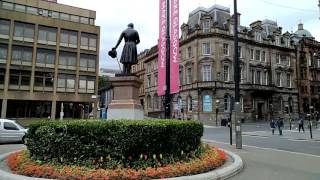
George Square was founded in 1781 and named after King George III. The beautiful City Chambers is located on the east side of the square. The square is full of many statues and monuments dedicated to some of the most famous Scottish figures: Artists, Scientists, and Politicians and surrounded by pubs and restaurants.
- Glasgow Botanical Gardens
The 200 years old botanical garden is a must-see in Glasgow. Thousands of plants, trees, and flowers, raised and flourish in several glasshouses. One of them is the Kibble Palace - a 19th-century beautiful glasshouse use to host exhibitions and concerts. For more information, go to The Botanic Gardens Website.
- St Mungo Museum of Religious Life and Art
St Mungo Museum of Religious Life and Art is a beautiful museum named after Glasgow's patron saint, who brought Christianity to Scotland 1,500 years ago. The museum's galleries house stunning works of art, aside from artifacts and beautiful displays, yet not too serious, of faith and religions from around the world. Admission is free.
- The Hunterian Art Gallery Glasgow
The Hunterian Art Gallery and The Mackintosh House are located just in front of The Hunterian Museum. The art gallery houses some significant art collections, including Rembrandt, Chardin, Stubbs, Whistler, Mackintosh, and Scottish Arts, especially the Glasgow Boys and Scottish Colourists. Admission to the art gallery is free. The Mackintosh House displays a strict reconstruction of the inner space of the house of Charles Rennie Mackintosh and his artist wife, Margaret Macdonald. They lived in the next street from 1906 to 1914. The rooms are furnished with Mackintosh's original furniture and decorated as close to the original as it can. Unfortunately, taking pictures is forbidden in the Mackintosh house, so you will have to trust me on this one - make a visit to the museum. It costs a few pounds, and maybe you will have to wait (because they only allowed 12 people in the tiny house simultaneously) - but it is worth it.
- The Tenement House Glasgow
enement houses were the most popular form of housing in Glasgow in the 19th and early 20th centuries. They served a broad range of social classes. However, most of the Tenement houses were demolished and replaced by tower blocks. The Tenement House in Glasgow, restored by the National Trust, is like a time capsule, provides a unique glimpse of life in the Tenement house in the early 20th century. On the first floor of the building, you will find the cashier and a small exhibition about Miss Agnes Toward, who lived there for more than 50 years. The house is located on the second floor and lighted by authentic gas lighting. So it is pretty dark inside. However, you can still be impressed by all the old items and the house's unique structure, that able to provide many solutions for daily life in a small area. Don't forget to check the opening hours - they change by the season.
- The Lighthouse Glasgow
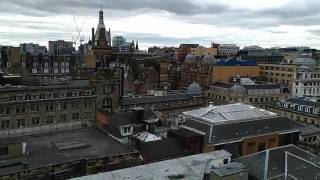
Scotland's Centre for Design and Architecture is a visitor center and a museum located in a Mackintosh-designed building. The Lighthouse has the most beautiful 360 degrees view of the city from the Viewing Platform on level six. It is most recommended to climb the helical staircase of Mackintosh Tower right to the top. You can access the stairs from the back of the Mackintosh exhibition on level three. You can also access the Viewing Platform by a lift.