776 results found with an empty search
- Mi'ilya
A great tour in the village of Mi'ilya in the Western Galilee. The tour guide Elias, who lives in Mi'ilya, took us to great places. In Mi'ilya live about 3300 Greek Greek Christians. You can get to these places alone and for free, but there is no substitute for a tour with the locals. Here are several of the fascinating sites we saw: 📍 The antiquities under Chateau du Roi - natives of Mi'ilya lived in Rome for about thirty years and specialized in cooking there. They returned to Mi'ilya and opened this Italian restaurant. In their cellar, a huge cistern and an old wine factory from the Roman period were discovered. Behind the restaurant, there is a beautiful view of the area. The floor of the restaurant is transparent and below it you can see the remains. 📍 Church Square - In the square you will find a small and beautiful Greek Orthodox church and 3 statues with interesting stories: A statue commemorating the Crusade of the King of Hungary to Mi'ilya, a statue of Tumarkin in protest of land expropriation in 1979 to erect Mitzpe Hila and a statue of St. Mary. 📍 Arak distillery - Basel, the owner told us about arak distillation traditionally. The distillery is located in a house that his family built in 1914. Inside you will see how they once lived in an Arab village. 📍The mosaic in the house of the Araf family - when the family members wanted to renovate their home, they found a Byzantine floor with a mosaic of a church. It dates to the fourth or fifth century. This is how they live, with two rooms that are a museum. They let travelers enter and see the antiquities for free. The garden that the landlady cultivates is stunning in its beauty. 📍The Eagles Cliff - one of the most impressive viewpoints of the area. Please note - the place is not fenced. It is not advisable to get there with children. Elias' Phone number for booking tours is: 0522829963 Enjoy 🤗
- The Bahai Gardens in Acre
The Baha'is have two centers in Israel – Haifa and Acre. I feel the temple and gardens in Haifa are more familiar. The gardens in Acre are a place worth visiting - like a trip abroad. This spacious area is carefully manicured with pleasant paths and trees, flowers, and shrubs pruned in perfect order. All the paths lead to the center, which includes the mansion and temple of Bahá’u’lláh, the Prophet who founded the Bahá’í religion. This section which consists of some of the gardens next to it, is now closed due to the Corona. The walk in the gardens is easy, short, and pleasant. Please note that the gardens are part of a religious site. Visitors are asked to arrive in modest attire (cover the shoulders and pants - up to the knees). Enjoy🤗
- The Mizgaga Museum
The Glazing Museum at Dor Beach is small and charming. It is dedicated to the history of glass and the area's history. The building was formerly used as a glass bottle factory for the wineries in Zichron Yaacov and Rishon Lezion. In the late 19th century, the place was closed and stood desolate for almost a century until it was restored and turned into a museum. In the small and aesthetic rooms, you can find glassworks, marine archeological discoveries from the area, and short films. For 15 NIS, you can buy the children a booklet with which they move between the rooms. The booklet is suitable for children who read, and my partner's 11-year-old daughter did it with great pleasure. I highly recommend going down to the stunning beach afterward. Now out of season, it is almost empty and great fun to hang out in it. Enjoy🤗
- Cyclamen Hill in Ramot Menashe
A lovely and easy hike on Cyclamen Hill in Ramot Menashe. The Ramot Menashe area is stunning now, and you will see beautiful green fields cows grazing in the meadow peacefully. The ascent to the hill is easy, and the route is circular. It is suitable for families, and you can enjoy the cyclamen, the blossom, and the fantastic green fields on the way. If you fancy a picnic - on the other side of the road there is a hill with some picnic tables. Enjoy🤗
- Artists' Stables in Pardes Hanna
The Artists’ Stables in Pardes Hanna is a great place for Friday morning-noon. Local artists took an old horse stable complex of the agricultural school in Pardes Hanna and turned it into creation, craft, and art complex called the artists' stables. It's lovely because they have kept the original structure and put into it their charm with small and special shops each offering something different. There you will find clothes, second-hand shops, jewelry, household items, shoes, food, chocolate, space for alternative treatments, special artwork, and even card reading. All this is alongside eateries, outdoor music, and a great atmosphere. And why Friday? Because then there is an atmosphere of happening with music, performances here and there - colorful, fun. Equal. During the week not the whole area is open. The stable area is also open Wednesday-Thursday. Opening hours on Friday: 10:00 - 15:00. Enjoy🤗
- Nahal HaShofet (Hashofer Stream)
The introduction to the following recommendation is critical: arrive only from Sunday to Friday. Do not arrive on Saturdays and holidays. In the middle of the week and on Friday you can enjoy the beauty you see in the pictures, and on Saturday it is highly crowded. Nahal Hashofet is a lovely hike along the stream and surrounded by vegetation. You will also see caves, waterfalls, and the remains of a flour mill. This is a circular trail of about a kilometer and a half. You go up a parallel path in the cave area and come back to the parking lot through Maayan Emi. I must say that in my opinion, it is better to walk the route to the end (the flour mill and the exit to the road) and return the same way. This route is so beautiful that it is better to do it twice than to return in a less interesting parallel path. Enjoy🤗
- Three and a Half Days in Vienna
Liat was attending a conference in Vienna – the historic capital of the Habsburg Empire and the Austrian state. The meeting took place in December, so we had a dilemma: we don't usually travel in winter to cold places. And also, the days are concise due to early sunset. However – it was only three and a half hours flight, and getting to Vienna with a low-cost airline is also very cheap. So, we decided to try. As it happens often, there was a delay in taking off, so we landed in Vienna an hour late. Nevertheless, we bought a 72-hour ticket to Vienna's super-efficient public transportation system. The ticket covers the metro, trams, and buses. Then we and went directly to our hotel: Ibis Styles Wien Messe Prater – a new hotel with tiny rooms, a spectacular lobby, and a surprising breakfast. It was already afternoon, so we looked for the closest site to visit: Hundertwasser Museum. The place is dedicated to Friedensreich Hundertwasser – a Jewish-Austrian artist, painter, sculptor, and architect, considered one of the most famous artists of Austria. Most of the museums in Vienna close at 18:00, so we headed to the largest Christmas market located in front of the City Hall: 150 stalls of artists, decorations sellers, hot dogs, and punch. We are not used to Christmas markets, so all the lights and colors make a big impression. We tried it all: two hot dogs, soup in bread, and some different types of punch. Fun. The next day, we wanted to visit the synagogue in the old city, but it wasn't open to visitors. So instead, we saw the Wiesenthal Institute just next to it. It's a museum and research library founded by Simon Wiesenthal, the famous Nazi hunter who looked for Nazi criminals worldwide. We went in to explore the small exhibition about the life of this unusual and brave man. Afterward, we headed to the Judenplatz, where the old synagogue burned down in 1421 when the emperor burned all the Jews who refused to convert their religion to Christianity. Above the ruins of the temple now stands the Judenplatz Holocaust Memorial, revealed in the year 2000. There is also a museum with an exhibition of Vienna's Jewish community in the middle ages and temporary displays. Not far from the Judenplatz stands a branch of Aida café. It looks very prestigious, with tens of coffee types and cakes – we had to get in. We ordered coffee, strudel (the famous Austrian cake) and a cheesecake. It was horrible. The service was terrible, either. Stay away. After a short visit to the vast St. Stephan Cathedral, we headed to the second part of the Jewish Museum, a few minutes walk from the first one. The museum tells the story of the three Jewish communities of Vienna: the first was in the middle ages, ended tragically by Albert V, Archduke of Austria. The second community lived here from the 16th century until most of the 185 thousand Jews of Vienna got murdered during the Holocaust. After 1945, the Jewish community in Vienna started recovering slowly. We hoped to eat an authentic Wiener Schnitzel – a traditional Austrian fried dish made of veal covered with flour, eggs, and breadcrumbs. There is a famous restaurant in the old town, but their two branches were full, so we ate our lunch at a nearby restaurant called Lugeck. It was tasty and a little bit expansive. Full and satisfied, we walked to the apartment of Sigmund Freud, the father of Psychoanalysis. Unfortunately, the nowadays museum isn't so friendly to visitors. There are only one reconstructed room and lots of pictures and exhibits, which you can learn about only with an app on your smartphone. I was glad to see they have big plans for redesigning the whole place in the year 2020. It's needed. The sunset in December comes at 16:00, so we went back to Stephanplatz, the city's main square near the St. Stephan Cathedral. First, we examined the Christmas market in front of the Cathedral. Then, of course, we drank punch. It looks like everybody drinks punch. It helps with the cold. And we ate hot dogs - they are so delicious… We got up early on the third day and went to another hotel: Mercure Wien Westbahnhof on the other side of the city. The conference of Liat took place here, so we thought it would be more comfortable to sleep in here. It's located near the central railway station, and while finding our way, we saw a monument of a little sad Jewish child sits in a suitcase. A Memorial for the Kindertransport, an operation that sent thousands of Jews from Germany and Austria to the United Kingdom just before the Second World War started to save their lives from the Nazis. Liat went to her conference while I went on a day full of museums. I started in the Imperial Crypt, where 150 members of the Habsburg dynasty are buried. From there, I headed to the Austrian National Library. This beautifully decorated hall is full of explanations about the library's history and its content. Very impressive. By the way, there are long lines for tickets. While standing in the front, I ordered a ticket online. By the time I finished the process and got mobile access directly to my smartphone, I was only in the middle of the line. Keep in mind - when traveling time is short – you don't want to waste it on lines. After a necessary sausage, I went to the apartment of Viktor Frankel, the founder of Logotherapy. Frankel wrote dozens of books, including "Man's Search for Meaning," which describes his experiences as a prisoner in Nazi concentration camps. It's is an unusual museum, without any renovated rooms, but with lots of detail about Frankel and the theory, including examples. Very nice place for people who love to read and learn. Liat joined me, and we went to the Naschmarkt – the most famous market in Vienna. It's a huge outdoor market, with all the ordinary things you can find in European markets: cheese, meat, fruits, and vegetables. I loved the delicatessen very much. The dry fruits and olives, filled with cheese, look and tastes great. We took a walk on the Ringstrasse. The ring road surrounding the Old City contains palaces and important cultural institutions. Unfortunately, we failed to find good strudel, so we ended the day with pizza at the Stephanplatz. The next day I took a metro ride to the Gasometer – a massive complex of four round buildings that used to be gas tanks until 1984. Then, they were transformed into a lovely compound of residence, shopping malls, offices, and entertainment. From there, I went to see the marvelous Hundertwasser House. It isn't surprising the place is full of tourists who came to admire the unique style. At noon, I went with Liat to the Strudel Show in Café Residenz inside the Schönbrunn Palace-yard, where the palace bakery operated. Finally, we got to taste an authentic Vienna-style strudel. Afterward, we took a tour inside the palace. Lucky us, I bought tickets in advance so we could skip the line. When purchasing tickets, you must obligate to a specific hour, because the place is overcrowded. We saw people who had to wait more than two hours to get in. After the tour, we enjoyed walking between the Christmas market stalls in front of the palace. Also, we took a short walk in the snowed garden behind the castle. It was a perfect ending to our winter tour to Vienna. No doubt we will come again – Vienna is one of the most beautiful and pleasant cities in the world.
- Hudertwasser Museum in Vienna
Friedensreich Hundertwasser (1928-2000) was a Jewish-Austrian architect and artist and is considered the most famous artist of Austria at the end of the 20th century. Unfortunately, most of his family got murdered during the Holocaust. As an architect, he developed a unique style that avoids straight lines, full of colors, and merges with nature. Kunst Haus Wien - Museum Hundertwasser was designed by Hundertwasser and displays his art collection, alongside permanent exhibitions of photography. To the Museum Website
- Hundertwasser House in Vienna
The Hundertwasser House in Vienna is a residential building. Hundertwasser was invited by the city to design a structure according to his architectural concept. The house was completed in 1986 and serves as a magnet for many curious tourists. To the Hudertwasser House Website
- Museum Simon Wiesenthal in Vienna
Museum Simon Wiesenthal is part of Wiesenthal Institute, located in the old city of Vienna. Simon Wiesenthal, a Holocaust survivor, dedicated his entire life to research and seeking Nazi war criminals, bringing them to justice. As a result, he succeeded in prosecuting more than 1,100 war criminals charged with mass murders during the Holocaust. The small museum commemorates Wiesenthal's life and work. I came here by accident - I wanted to visit the synagogue located a few meters from the institute. When I saw the museum, I decided to get in. I was staying there for half an hour. Interesting and important. To the Museum Website
- Judenplatz Holocaust Memorial in Vienna
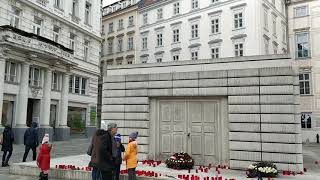
The Judenplatz Holocaust Memorial is the central memorial for more than 65 thousand Holocaust victims of the Jewish-Austrian community. Simon Wiesenthal was the initiator of the monument, and the city of Vienna built it. The monument is located at Judenplatz, in the old city of Vienna. It was the place of the ancient synagogue of the middle ages Jews of Vienna, and it burned down in 1421 alongside 270 Jews who refused to convert their religion. The other Jews were banished from the city. The remains of the old synagogue are buried under the memorial. They can be accessed and seen through the near Judenplatz Jewish Museum. The memorial looks like a library, symbolizing the spirituality of the Jewish people.
- Jewish Museum Vienna
The Jewish Museum in Vienna consists of two main buildings. The smaller one is located in the Judendplatz, near the Judenplatz Holocaust Memorial. This museum displays the remains of the burned middle ages synagogue, alongside an exhibition of Vienna's middle ages Jewish community and temporary displays. The Main building, Museum Dorotheergasse, is much more prominent and tells the story of the Jews in Vienna before and after the Holocaust. The museum also has temporary displays. The entrance ticket is valid for both museums. The distance between them is approximately 9 minutes walk. To the Museum Website Museum Judenplatz Museum Dorotheergasse